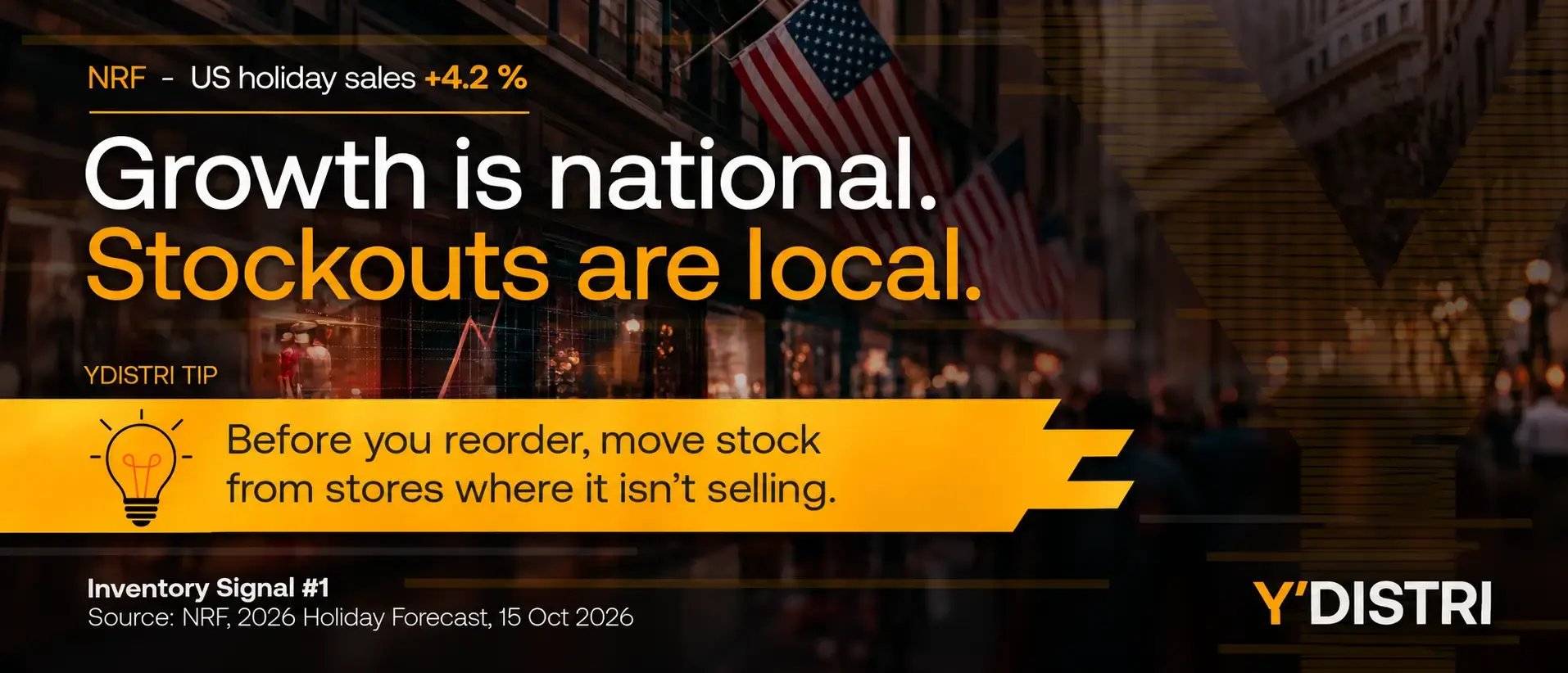
Holiday demand will grow this year. It will not grow evenly across your stores, and that gap decides how much of the extra demand you actually sell.
The National Retail Federation (NRF) forecasts US retail sales for November and December 2026 to grow 4.2% over last year, to $1.013 trillion. Last year, holiday sales grew 3.1%.
NRF also expects inflation and higher gas prices to hit shoppers in different income groups in different ways. In other words, the national number hides very different stores.
What it means at store level
A 4.2% national forecast says nothing about which store will sell what. At peak, some locations sell out of key items in days. Others sit on the same items, in the same sizes, until the season ends and the markdowns start.
Both problems sit inside the same chain. One store is losing full-price sales. Another is building next year's dead stock.
Our tip: check your other stores before the supplier
When a store runs out at peak, the reflex is to reorder. But a supplier order takes time, and at peak it can arrive after the demand has gone. The faster source is often the stores where that stock isn't selling.
- Find the stores that hold the item but sell it slowly.
- Compare the expected full-price sale in the store that ran out with the cost of the move.
- Move the stock, then reorder only what the chain as a whole is missing.
Moving stock is faster than a reorder, and it sells stock you already own at full price instead of marking it down later. YDISTRI's benchmark: 90% of redistributed stock sells at full price within three months.
Find the stock your stores are missing
See how YDISTRI shows which stores hold the stock others are running out of, so you can move it while it still sells at full price.